Saturday, April 21, 2007
maria full of grace (marston, 2004)
Near the end of the film, Maria (Oscar nominee Catalina Sandino Moreno) walks past a sign that says "It's what's inside that counts." It's director Joshua Marston's grotesque lack of subtlety that seals the deal: you see, Maria is an expectant mother.

Thursday, April 19, 2007
cyrano de bergerac (rappeaneau, 1990)
Engrossing and amusing despite Rappeaneau's relentlessly prosaic treatment; to my surprise, a number of key moments are quite moving, thanks mostly to the film's even-handedness and a thoroughly engaged cast. A "Masterpiece Theater" piece of work, but in a good way. The film's key asset for English-speaking audiences is its subtitles, rendered by novelist Anthony Burgess.
neapolitan diary (rosi, 1992)
Mostly inept docu-travelogue follow-up to Rosi's Hands Over the City. Alternates between a visit by Rosi and a two-person documentary crew (plus video camera operators) and a series of "talking head" segments featuring Neapolitan academics and authority figures; there are intermittent clips from Rosi's fictional oeuvre (not just Hands but Lucky Luciano and Illustrious Corpses, others). Strangely enough, the "talking head" segments ground the project and keep Rosi focused...elsewhere, Diary is an innocuous mess.
Monday, April 16, 2007
cotton comes to harlem (ossie davis, 1970)
Not an unpleasant picture, unsweetened but uncoordinated. Raymond St. Jacques' face is shaped like an arrow; Godfrey Cambridge's face is shaped like a smirk. Attempts to pander to the white audience are negligible; more often the film does the opposite...in a key scene, black winos ease their way into a peaceful protest, but when angry whites try to join the same cause and take up the same slogans, they get a pie in the face!
What the film has to say about sexuality and race is enough to fill an essay: the fact that "Gravedigger" Jones / "Coffin" Ed Johnson appear to have even less of a home life than Joe Friday / Frank Smith is just the beginning.
Most of all, the film poses a key question to its viewers: is it black enough for ya?
What the film has to say about sexuality and race is enough to fill an essay: the fact that "Gravedigger" Jones / "Coffin" Ed Johnson appear to have even less of a home life than Joe Friday / Frank Smith is just the beginning.
Most of all, the film poses a key question to its viewers: is it black enough for ya?
Sunday, April 15, 2007
hands over the city (rosi, 1963)
The worst scene in the film, undoubtedly, is the one that contemplates the corrupt Edoardo Nottola contemplating his arrival at a moral/political crossroads. Rosi cannot contemplate silently: the music (full of bombast) suggests inner turmoil, the camera wanders restlessly, Steiger moves across spaces as if deep in contemplation. What is the subject of the preceding scene? Nottola is given a Big Choice. And the scene that follows? He makes a Big Decision.
As in The Mattei Affair, Rosi's visual flourishes are scarce but extra-vivid by virtue of their scarcity: council members display their open palms and proclaim that they are clean; a crowd of poor Neapolitans are on the cusp of open rebellion in one scene, pacified and dulled in the next. For the most part, however, one is not certain whether Rosi has succeeded in de-dramatizing an exciting tale of corruption and back-room dealing or failed in dramatizing several volumes of city council minutes.
One of the things that made The Great McGinty exciting was that it fessed up to corruption's attractive qualities and saw no reason to wash its hands. Rosi's true hero is the moralist De Vita, who would spend all his imaginative energy telling us that McGinty is corrupt, a scoundrel, and a crook.
As in The Mattei Affair, Rosi's visual flourishes are scarce but extra-vivid by virtue of their scarcity: council members display their open palms and proclaim that they are clean; a crowd of poor Neapolitans are on the cusp of open rebellion in one scene, pacified and dulled in the next. For the most part, however, one is not certain whether Rosi has succeeded in de-dramatizing an exciting tale of corruption and back-room dealing or failed in dramatizing several volumes of city council minutes.
One of the things that made The Great McGinty exciting was that it fessed up to corruption's attractive qualities and saw no reason to wash its hands. Rosi's true hero is the moralist De Vita, who would spend all his imaginative energy telling us that McGinty is corrupt, a scoundrel, and a crook.
Saturday, March 10, 2007
...and scary movies
Two recent non-horror films I've had the privilege to see - both great, and both scary as hell: Anthony Mann's Border Incident, with its insectile bandits and cutthroats and the nigh-unbearable scene of murder-by-plow. This film is a close cousin of T-MEN for a number of reasons: both films relate the story of undercover agents who spend time apart from each other while pursuing an elusive center to an unnavigable criminal structure. Both films have documentary book-ends and exhibit strong faith in the moral correctness of government law enforcement. Ricardo Montalban is the lead, his softness is not a liability, but a feature of his identity, remarked upon more than once. The cast is made strong by its supporting characters - Howard Da Silva, Arthur Hunnicutt, Sig Ruman, Arnold Moss, and James Mitchell. As for the look of the movie, well, let's just say it's not found dead-center between Mann's claustrophobia-inducing noirs and severe-angled westerns for nothing.
Raoul Ruiz's Hypothesis of the Stolen Painting, whose terrifying aspects are less direct; the film is a unique puzzler but the ending gave me a pretty decent shake. Ruiz piles on misdirection after misdirection so that when he ultimately suggests a real vector (get OUT!), the effect is cathartic. The cumulative effect of so many living, breathing (twiching!) mannequins was of strangulation.
Raoul Ruiz's Hypothesis of the Stolen Painting, whose terrifying aspects are less direct; the film is a unique puzzler but the ending gave me a pretty decent shake. Ruiz piles on misdirection after misdirection so that when he ultimately suggests a real vector (get OUT!), the effect is cathartic. The cumulative effect of so many living, breathing (twiching!) mannequins was of strangulation.
Thursday, March 01, 2007
spook films 2007
It seems like ever since the American remake of The Ring, there's a new type of horror film, of which type we see a specimen about once a month. I'm not talking about The Hills Have Eyes and The Devil's Rejectsand other s&m fantasies, but those slight things that don't appear to have cost a lot, don't make a lot, and are gone in the blink of an eye...that is, unless you take the time to seek them out and write/talk about them. They're probably mostly awful but some look interesting. I waded through a lot of crap in 2003-2005 and it was all worthwhile when I came across The Exorcism of Emily Rose, which isn't even that great of a movie - mostly because the plot is a laugh - but which was very appealing to me for its craftsmanship and its unexpected layer of empathy (which is grudgingly revealed).
For this reason I feel like I need to log the names of these now-you-see-them,-now-you-don't spook movies (perhaps we can coin a new term: not-quite-straight-to-video) and check them out on DVD. The old-timey auteurist practice of trawling the movie theaters is too costly but the age of home video has provided a short circuit that I find welcome.
For this reason I feel like I need to log the names of these now-you-see-them,-now-you-don't spook movies (perhaps we can coin a new term: not-quite-straight-to-video) and check them out on DVD. The old-timey auteurist practice of trawling the movie theaters is too costly but the age of home video has provided a short circuit that I find welcome.
Sunday, February 25, 2007
little pancho vanilla (tashlin, 1938)
Tashlin is not the most mad of all the Warner directors (that was Clampett) but his films are frequently the most emotionally grounded, as mad films often are. They may or may not pause for very long to reflect on things like romantic ecstasy, pathos, or terror, but these moments are striking, strangely moving, and have the power to restructure the rest of the surrounding narrative in perspective. Examples include: the pitiful woodland creatures in Porky in the North Woods; declarations of love between Tom Ewell and Jayne Mansfield in The Girl Can't Help It; the narrative-arresting musical numbers in the same film; the distraught, suicidal girl in The Disorderly Orderly; the gamut of emotions (from abject terror to indifference to proud showmanship) exhibited by Early Porky Pig in Little Beau Porky and The Case of the Stuttering Pig, among others.
Tashlin will frequently bend or break his film in order to follow a train of thought, an idea (or a herd of ideas), or a simple whim. One of my favorite examples is the ridiculous interruption of Little Pancho Vanilla with a trio of fruit-bearing, diminutive singing ladies who then proceed to swoon over a poster of a Clark Gable look-alike (as only Tashlin could imagine him). Prior to their arrival, Vanilla affects something like pastoral realism - or what passes for it, in Looney-land - in its depiction of a provincial Mejican village; afterwards, every absurdity is acceptable, peaking with a speaking bull's transformation of a disparate crew of matadors into identical billiard balls.
Tashlin will frequently bend or break his film in order to follow a train of thought, an idea (or a herd of ideas), or a simple whim. One of my favorite examples is the ridiculous interruption of Little Pancho Vanilla with a trio of fruit-bearing, diminutive singing ladies who then proceed to swoon over a poster of a Clark Gable look-alike (as only Tashlin could imagine him). Prior to their arrival, Vanilla affects something like pastoral realism - or what passes for it, in Looney-land - in its depiction of a provincial Mejican village; afterwards, every absurdity is acceptable, peaking with a speaking bull's transformation of a disparate crew of matadors into identical billiard balls.
Thursday, February 22, 2007
retribution (kiyoshi kurosawa, 2006)
KK's new film prostitutes wholesale chunks of his three strongest features prior to this one: Cure (God Told Me To...Kill!), Pulse (the world is emptying itself out; ghosts are driven to insanity via an insurmountable loneliness), and Charisma (Koji Yakusho becomes the "messiah cop"). I did not mind this very much, because I have always felt that he's had bigger fish to fry than simple shock effects, even in a film like this, where the script seems to have been hastily prepared (he is his own writer) and the direction - while exceptional - doesn't go far in unmuddying the waters. The film is an embarrassment of riches for fans of the director's sense of architecture, boxes, unfinished surfaces and unnervingly "off" angles, sense of displacement.
There is a shot of the ghost creeping towards Yakusho. She creeps and creeps. She is not CGI'd in this shot. The two actors share the frame. There is no gauze over the lens. She creeps toward him like Snidely Whiplash would creep towards somebody. He cowers/she creeps. They resemble rehearsal partners - you expect someone to say "and...scene" at a certain point. I love this shot enormously.
A key moment suggests KK read Thomas Ligotti's 1989 short story "Dream of a Mannikin."
The bones call to mind Suzuki's Zigeunerweisen. I feel that KK pays homage to the "flawed" Sarasate record in that film several times: the sound reels in Seance (where a dead voice seems to have tainted their recordings), the film clips in Cure and Loft (in which an artwork/artifact from circa the 1920s hints at something far older).
There is a shot of the ghost creeping towards Yakusho. She creeps and creeps. She is not CGI'd in this shot. The two actors share the frame. There is no gauze over the lens. She creeps toward him like Snidely Whiplash would creep towards somebody. He cowers/she creeps. They resemble rehearsal partners - you expect someone to say "and...scene" at a certain point. I love this shot enormously.
A key moment suggests KK read Thomas Ligotti's 1989 short story "Dream of a Mannikin."
The bones call to mind Suzuki's Zigeunerweisen. I feel that KK pays homage to the "flawed" Sarasate record in that film several times: the sound reels in Seance (where a dead voice seems to have tainted their recordings), the film clips in Cure and Loft (in which an artwork/artifact from circa the 1920s hints at something far older).
Tuesday, December 13, 2005
watching star wars
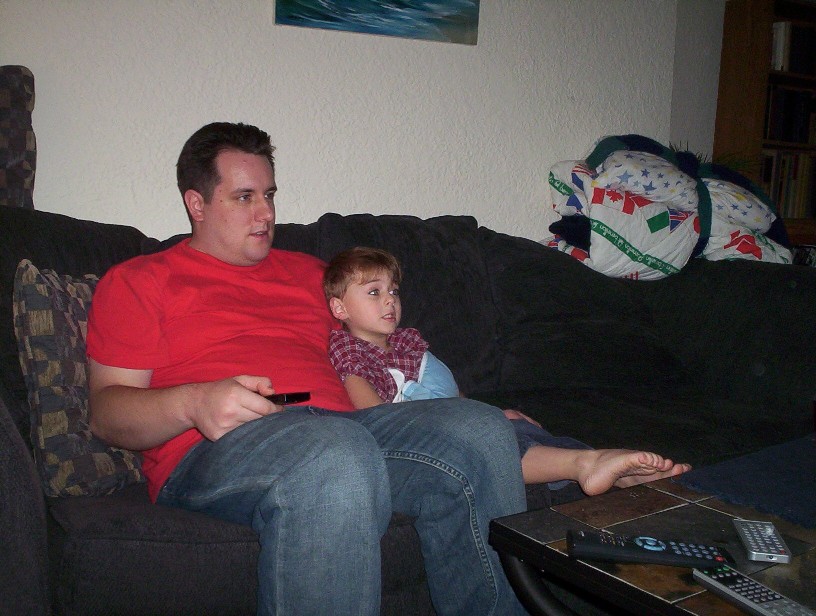
On the right, your faithful commentator. On the left, my girlfriend's son, Mohammad.
On the tube: Star Wars (George Lucas, 1977) on laserdisc. The plot: too complex for this guy, although he had no trouble with Phantom Menace and Attack of the Clones. Seems to prefer the cartoons. All-time favorite song, from which he can quote at will: "I'll Make a Man Out of You". Looney Tunes are perrrrfect.
Yes, that's a cast on his arm. From an injury incurred during a performance of "Shark Dance Number 1" (don't ask, I wasn't there).
Top of frame, center, more or less hidden: an oil painting by my father, Jim Christley.
Friday, November 25, 2005
same time, next year (mulligan, 1978)
This has wonderful performances by Alan Alda and Ellen Burstyn, but really hits the mark thanks to Mulligan's effortlessly graceful touch. Mulligan was one of the last and best classical stylists, and this "stagey" movie from 1978 has more in common with Summer of '42 and The Man in the Moon than its reputation lets on. Just look at the exteriors, which prove that it's all right for moviemakers to push a stage piece "out of doors" for no justifiable narrative reason, because one of the best reasons of all is to revel in the gorgeous, heavenly colors and expressive compositions of a Mulligan/Surtees collaboration!
Wednesday, November 09, 2005
fitty cent

So these ads for GET RICH OR DIE TRYIN' have been all up in my grill for what seems like nigh on a year, but only a few minutes ago it occurred to me that - not to say that there haven't been good candidates in the meantime - these ads are as worthy of a good, long look at the Star Image as Richard Dyer gave us with his seminal "Heavenly Bodies" essay. Can we count on Armond White to accomodate us?

Saturday, October 08, 2005
the president's last bang (im, 2005)
From South Korea, the assassination of Park Chung-hee is played out as a thriller-comedy that's neither thrilling nor funny. Nicely shot, but seems to have been made by people who forgot why they were making the picture shortly after they began shooting it, except for a half-hearted attempt to make a Costa-Gavras agitation piece by way of My Wife is a Gangster.
three times (hou, 2005)
Maybe what makes Hou such a tough nut for some people to crack is that everything he's doing with the cinema is right there on the surface: grooving on three kinds of nostalgia - for his own past, for a past he wasn't around for, and for a present that's slipping away (and seems to be filled with reminders of dissolution and regret). Practically all his major films have touched on one of these three nostalgias. Three Times is a luminescent primer.
gabrielle (chéreau, 2005)
For his newest film, acclaimed opera/theater/movie-director Patrice Chéreau shoots in 'Scope and duct-tapes his lenses to the actors' pores - looking for knots in the musculature. There are a few. This movie is green like aged copper, and brown, and heavy with shadows. A few isolated bright spots - in the parlor, in the kitchen - serve to remind us that it sucks to spend time there, too, as you only seem to've moved from a dark cellar to a brightly lit morgue. Chéreau and his co-writers have fashioned out of a Joseph Conrad story a plot that the movies have long since made tiresome: the currents of ennui and hatred that run through the Perfect, Bourgeois Household. But there is sustenance to be had from its technical qualities, which are faultless, and Pascal Greggory, who continues to prove that he is one of the world's best and most versatile actors.
professione: reporter (antonioni, 1975)
One of the best parts of this Antonioni film occurred after it was over: my walk around Lincoln Center, with its Milstein and Josie Robertson plazas, its various raised and street-level walkways, sky bridges, and rest areas, its inlaid reflecting pool, a fountain, bits of public art, stone steps that match the plaza's concrete tiles, and escalators. Some of the walls that overlook the plaza are marked by vertical ridges, some are smooth. From any given point in my walk I could see three or more of Lincoln Center's resident cultural institutions, such as the opera house, the library, the Julliard, or the Walter Reade Theater, where I saw Antonioni's well-regarded 1975 meta-thriller. Many of Antonioni's films have the power to re-energize my perceptions of space, especially when that space is as architecturally rich as Lincoln Center's open-air plazas and walkways. These spaces, this mega-space, is the site of thousands of personal interactions per day, and some of the areas are frequently commandeered as outdoor venues for musical and dramatic performances. I wouldn't exactly accuse Lincoln Center of imprisoning its patrons in the same way many architectural forms seem to oppress us on the sly, but many of the points around the plazas and walkways are used for one thing only, each, day in and day out. Places for walking are rarely used for milling about and vice verse; places for sitting and reading are kept clear of major traffic routes; the wide-openest, most blank areas have a curious way of keeping people around the perimeters, for the most part, as if in anticipation for its use as a performance space, or, perhaps, in honor of the memory of one.
The architecture in Profession: reporter is on display almost in an offhand manner - compare this to L'Avventura or L'Eclisse or Blow-Up, in which practically everything in each movie serves as an underpinning for the archways, yachts, columns, plazas, shops, mod apartments, and great big rocks. (Don't hold me to this. I'm still figuring the guy out and I know things are more complicated than that. Thanks.) By the time you get a fix on a single space in P:r, on a desert or a hotel or whatever, Antonioni (and Jack Nicholson, who is in 9 out of 10 shots) has already packed up and moved to the next one. Much of the film works to erase what's come before it, illustrating the notion that things disappear not just when you've turned your back on them, but because you've turned your back on them. The film doubles back at several points and finally ends on a technical and physical feat of doubling back - but each time it does so, the information has been shot through by what we've already seen in the film's present-moment layer. There's a flashback to Locke's home in the UK but it's as if it's not to be believed. The same goes for the flashback that resurrects the dead man, Robertson: his living character, his backstory, his talk with Locke, these things have a creepy, enervating quality of having been invalidated, hollowed out, of staying past their sell-by date. As the movie, as Locke, traipses across the globe, flip-book style, death follows him (literally) as the film itself seems to dissolve before our eyes. The final look-back is of a dead man in a room that no longer matters and a wife who won't identify him. All the characters of the film gather around Locke for a ritual annihilation.
The architecture in Profession: reporter is on display almost in an offhand manner - compare this to L'Avventura or L'Eclisse or Blow-Up, in which practically everything in each movie serves as an underpinning for the archways, yachts, columns, plazas, shops, mod apartments, and great big rocks. (Don't hold me to this. I'm still figuring the guy out and I know things are more complicated than that. Thanks.) By the time you get a fix on a single space in P:r, on a desert or a hotel or whatever, Antonioni (and Jack Nicholson, who is in 9 out of 10 shots) has already packed up and moved to the next one. Much of the film works to erase what's come before it, illustrating the notion that things disappear not just when you've turned your back on them, but because you've turned your back on them. The film doubles back at several points and finally ends on a technical and physical feat of doubling back - but each time it does so, the information has been shot through by what we've already seen in the film's present-moment layer. There's a flashback to Locke's home in the UK but it's as if it's not to be believed. The same goes for the flashback that resurrects the dead man, Robertson: his living character, his backstory, his talk with Locke, these things have a creepy, enervating quality of having been invalidated, hollowed out, of staying past their sell-by date. As the movie, as Locke, traipses across the globe, flip-book style, death follows him (literally) as the film itself seems to dissolve before our eyes. The final look-back is of a dead man in a room that no longer matters and a wife who won't identify him. All the characters of the film gather around Locke for a ritual annihilation.
Subscribe to:
Posts (Atom)